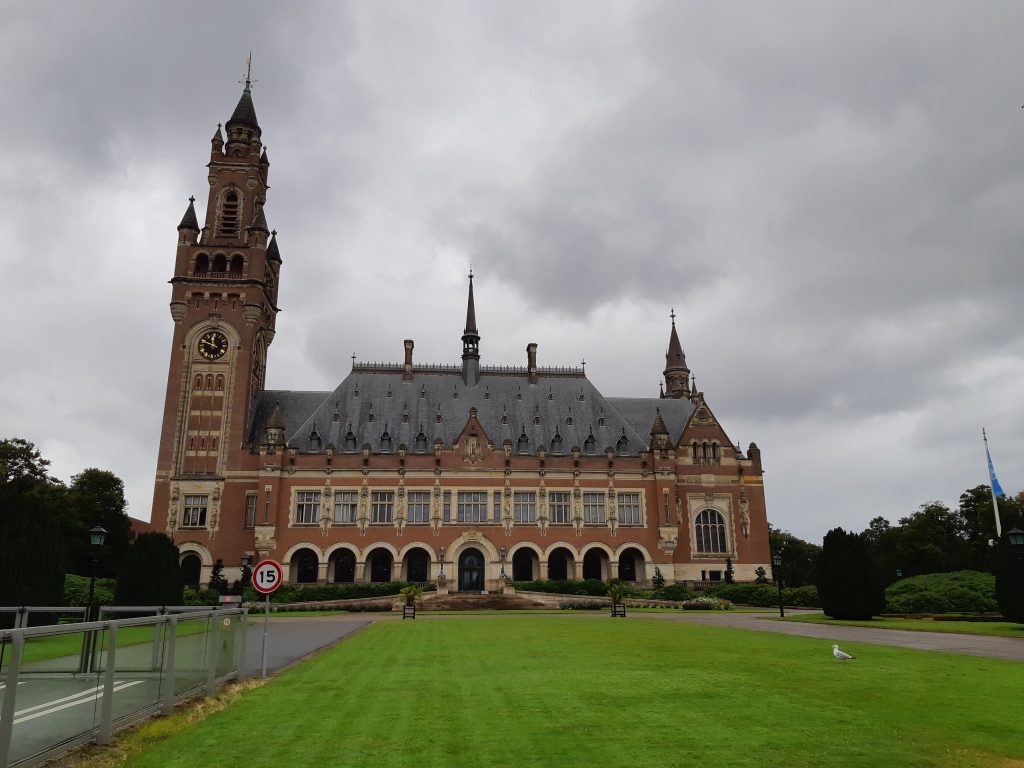
On the 23rd July 2025, the International Court of Justice (ICJ) delivered an Advisory Opinion in regards to the ‘Obligations of States in respect of Climate Change.’
In May 2026, the ICJ’s Advisory Opinion was backed by the UN General Assembly through a new resolution put forward by Vanuatu.
In this blog, I’ll explain the events that led here and the implications of these outcomes.
ICJ Advisory Opinion – July 2025
The Advisory Opinion was requested by the UN General Assembly in 2023, when they asked the ICJ to consider the following questions:
- “What are the obligations of States under international law to ensure the protection of the climate system and other parts of the environment from anthropogenic emissions of greenhouse gases for States and for present and future generations?
- What are the legal consequences under these obligations for States where they, by their acts and omissions, have caused significant harm to the climate system and other parts of the environment, with respect to:
- States, including, in particular, small island developing States, which due to their geographical circumstances and level of development, are injured or specially affected by or are particularly vulnerable to the adverse effects of climate change?
- Peoples and individuals of the present and future generations affected by the adverse effects of climate change?”
The ICJ received 91 written statements and 62 comments, in addition to oral statements from 96 States and 11 organisations. The press release states this is the most participation for any case that the ICJ (or its predecessor, the Permanent Court of International Justice) has ever had.
The Advisory Opinion was adopted unanimously, which is only the fifth time this has happened.
ICJ’s Response to Question A
In answer to Question A, the ICJ laid out the responsibilities countries have under existing international agreements. Some of these responsibilities include:
- Under the UNFCCC, States are obligated to mitigate emissions and adapt to climate breakdown.
- The 43 countries listed in Annex 1 have additional obligations to lead on the climate crisis.
- States are duty bound under the UNFCCC to work with each other to tackle the climate emergency.
- States signed up to the Kyoto Protocol are duty bound to comply with its provisions.
- States signed up to the Paris Agreement are obligated to submit their individual National Determined Contributions (NDCs), which combined should be “capable of achieving the temperature goal of limiting global warming to 1.5°C above pre-industrial levels.” Note: For context, we overshot the 1.5C target a couple of years ago, prior to this Advisory Opinion being released. Also, countries have failed to submit ambitious enough targets in their NDCs, with the world currently headed for either 2.3 – 2.5C of warming according to the COP30 Agreement, or 2.6C of warming according to Climate Action Tracker.
- States are obligated to implement measures that enable them to meet their NDCs.
- Under the Paris Agreement, States have obligations including financial and technology transfers to aid other countries.
Under customary international law, states are duty-bound to work together to “prevent significant harm to the climate system and other parts of the environment.” In addition, the Advisory Opinion says that:
- “States have a duty to prevent significant harm to the environment by acting with due diligence and to use all means at their disposal to prevent activities carried out within their jurisdiction or control from causing significant harm to the climate system and other parts of the environment, in accordance with their common but differentiated responsibilities and respective capabilities.”
Countries are obligated to protect the climate system and the environment from anthropogenic emissions under additional agreements including the Vienna Convention for the Protection of the Ozone Layer, the Montreal Protocol on Substances that Deplete the Ozone Layer, the Kigali Amendment, the Convention on Biological Diversity, and the United Nations Convention to Combat Desertification.
States are obligated to protect oceans from climate breakdown under the United Nations Convention on the Law of the Sea.
There are also additional obligations on States to protect the environment and climate system under international human rights law.
ICJ’s Response to Question B
In answer to Question B, the ICJ said that States which breach any of their obligations (as listed above) would be committing a “wrongful act.” States are duty bound to continue performing these obligations, including any that they’ve breached.
Where a State commits a “wrongful act,” legal consequences may include:
- Ceasing the wrongful act
- Providing guarantees and assurances that the wrongful act will not reoccur
- Providing “full reparation to injured States in the form of restitution, compensation and satisfaction, provided that the general conditions of the law of State responsibility are met, including that a sufficiently direct and certain causal nexus can be shown between the wrongful act and injury.”
In effect, this opens the door to legal challenges on high-emitting countries that are directly causing climate breakdown, which is leading to deadly weather events (and rising sea levels) around the world, particularly in developing countries – some of which have done little to cause this crisis, but are bearing the brunt of the impacts.

UN General Assembly Resolution – Adopted in May 2026
Nearly one year after the ICJ presented their Advisory Opinion to the UN General Assembly (who originally requested it), a resolution was adopted by the UN General Assembly on Wednesday 20th May 2026, to back the ICJ ruling.
The resolution had 141 votes in support, eight dissensions (Belarus, Iran, Israel, Liberia, Russia, Saudi Arabia, the US, and Yemen), and 28 who chose to abstain from voting.
The resolution calls on States to ensure they comply with their obligations set out in the ICJ’s Advisory Opinion. The wording here is important, especially the phrase “calls on,” which basically means that countries are being asked to do something, as opposed to being forced to do it.
This resolution isn’t legally binding. Neither is the ICJ’s Advisory Opinion, which is a desperate shame.
Nonetheless, both the ICJ’s verdict and the adoption of the subsequent resolution by the General Assembly could potentially be submitted with evidence in support of legal challenges against countries who fail to reign in their emissions and tackle the climate emergency. Whilst not legally binding, the Advisory Opinion and the Resolution carry weight which other courts would have to take into consideration in climate-related legal challenges. Both the Advisory Opinion and the resolution act as “signals” that preventing climate breakdown is a legal requirement, which countries are duty bound to adhere to.
Climate-related legal challenges have risen dramatically in recent years. As of June 2025, UNEP estimates there have been 3,099 cases filed across 55 national jurisdictions, as well as 24 regional or international courts. The Advisory Opinion and the Resolution could aid with cases like these going forward.
In 2027, the new UN Secretary-General will submit a report on how to ensure compliance with the ICJ’s verdict. In itself, this report won’t achieve much. But perhaps it might put some pressure on countries hampering climate action. Maybe then the COP climate summits could actually begin achieving meaningful outcomes, given that we’ve had 30 of these annual conferences.
Conclusion
I’m writing this as killer heatwaves grip much of Europe, during a summer that may go down in history as one of the most unbearable we’ve had – and which future generations may look back on as being ‘cool’ in comparison to the hothouse earth conditions that we’re creating.
These semi-legal outcomes (I call them semi-legal as they aren’t legally binding), will hopefully support climate-related cases against governments and organisations that are preventing climate action.
However, I worry that legal cases are slow and cumbersome, and climate change is progressing rapidly. Will countries respect legal outcomes of these legal challenges and act in the interests of our collective futures? I’m not so sure.
Our elected politicians have let us down for nearly 40 years since the world was first made aware of the climate emergency. I think we require a massive and rapid shift away from representative democracy to citizen-led participatory democracy, one of the few types that has historically been proven to work. A government led by ordinary citizens would be far more likely to respect these semi-legal verdicts and ensure adherence to international frameworks. Perhaps then, and only then, would we be able to tackle the entirety of the polycrisis.
A different and brighter future feels like it could be on the horizon if we choose to travel down this route. But it will require a hell of an effort to get there.
I sincerely hope that more people will get involved and help humanity shift our trajectory, because even in 2026 as the world crumbles around us, I see so many good people doing very little to help. This has to change.
Our future is being determined with every passing minute of ongoing emissions and lack of political action on the climate crisis. The time for global concerted action is passing as tipping points loom, so we have to make an extra big ongoing concerted effort if we wish to maintain a liveable planet. I believe this can be done, if we collectively chose to do so.
I’ve been writing about the climate emergency since 2016, and the AI crisis since 2023. I write all my own work, without the use of AI. I don’t publish on any other paid platforms, and my blog remains completely free to read. If you’ve found my writing informative and if you’d like to support my work, I’d be really grateful if you did so here. Thank you.
My cli-fi children’s picture book, Nanook and the Melting Arctic is available from Amazon, including Amazon UK and Amazon US. My eco-fiction children’s picture book, Hedgey-A and the Honey Bees about how pesticides affect bees, is available on Amazon’s global stores including Amazon UK and Amazon US.